Advertising and Public Relations · TEE · papers
Q7 · Discuss the Case Study of Nestle’s Marketing Strategy for Strengthening its Product—Maggi by explaining the following: (i) Completely discuss the case study. (ii) Interpret the important principles of advertising, which helped to increase the sales and reputation of the brand, with your critical comments on the case study
2023-12-05 · Semester V final / re-exam
Actual TEE paper · 100 marks · Q1 compulsory + any four complete Q2–Q7
2023-12-05 · Q7 · Previous-paper question. Discuss the Case Study of Nestle’s Marketing Strategy for Strengthening its Product—Maggi by explaining the following: (i) Completely discuss the case study. (ii) Interpret the important principles of advertising, which helped to increase the sales and reputation of the brand, with your critical comments on the case study. [20 marks]
Answer
1. Background and communication problem
2. Strategy and application of concepts
- Category and benefit: The product is positioned around a convenient food-preparation occasion. Explain the customer problem—wanting a familiar option with convenient preparation—before discussing the brand. Product directions and conditions still define actual preparation.
- Different decision roles: A child or student may request and use the product, while a parent or another household member purchases or prepares it. Communication can address taste and enjoyment for the user and convenience for the purchaser or preparer.
- Functional and emotional meaning: Convenience is a functional association; family care and shared moments are emotional associations. A strong answer explains how the same message can combine them, without claiming the product itself creates a caring relationship.
- Brand consistency: A recognisable name, packaging and repeated category cue can support awareness. Consistency helps a buyer identify an offering already associated with an occasion, while new creative can keep it relevant.
- Trial and repeat: Trial offers or initial experience can introduce the product; satisfactory use and reminders may support repeat. This provides a reasoned application of the Ehrenberg framework without asserting that Nestlé officially planned with that model.
- The full marketing mix: Advertising communicates the position, but distribution, price, availability and actual experience affect purchase. A campaign answer should not omit these supporting conditions.
3. Outcome and what the evidence permits
The reviewed sources support the presence of the convenience and relationship themes. They do not establish a campaign-specific sales uplift. Discuss their potential contribution to awareness, preference and repeat behaviour without inventing performance figures.
4. Critical comments
- A familiar food advertisement is not a nutritional recommendation. Do not infer health superiority from emotional appeal or a brand name.
- When the question names “marketing strategy”, discuss positioning and the marketing mix; do not replace the whole answer with the unrelated details of one crisis.
- Corporate campaign descriptions establish intended themes, not independent proof of causal sales impact.
5. Conclusion
The case is useful because it connects a defined audience need with a recognisable message and supporting action. A strong exam answer explains those connections and separates observed facts from assumptions about impact.
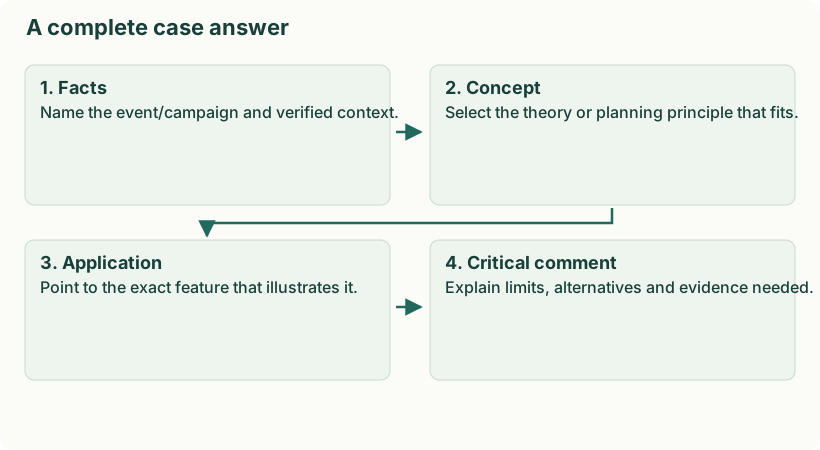
Diagram: A complete case answer. Labels: A complete case answer | A complete case answer | 1. Facts | Name the event/campaign and verified context. | 2. Concept | Select the theory or planning principle that fits. | 3. Application | Point to the exact feature that illustrates it. | 4. Critical comment | Explain limits, alternatives and evidence needed.