Advertising and Public Relations · TEE · papers
Q7 · Discuss the Case Study of Tata-Nano by explaining: (i) Background of the case study (ii) PR strategy (iii) Outcome
2024-05-02 · Semester VI final
Actual TEE paper · 100 marks · Q1 compulsory + any four complete Q2–Q7
2024-05-02 · Q7 · Previous-paper question. Discuss the Case Study of Tata-Nano by explaining: (i) Background of the case study (ii) PR strategy (iii) Outcome. [20 marks]
Answer
1. Background and communication problem
2. Strategy and application of concepts
- Background: An affordability proposition addresses a meaningful access barrier. A car purchase also involves safety perceptions, status, financing, reliability and service, making the decision more complex than price alone.
- Positioning: The intended benefit is accessible personal transport. A critical answer distinguishes “affordable value” from an audience interpreting the message merely as “cheap”. This is an analytical positioning risk, not a universal explanation of every buyer’s decision.
- PR and launch communication: A novel offering creates a newsworthy launch story. Accurate information must explain the actual variants, conditions, delivery and service rather than only the attention-grabbing headline.
- Decision roles: Families can involve initiators, influencers, deciders, purchasers and users. Each may evaluate the proposition differently; one low-price message may not resolve all concerns.
- Integrated marketing: Product experience, availability, financing and after-sales support determine whether awareness becomes a satisfactory purchase. Communication cannot replace these parts of the offering.
- Evaluation: Assess awareness, perceptions, trial/enquiries, purchases and longer-term experience separately. Launch publicity is an output/attention result, not sufficient evidence of enduring market success.
3. Outcome and what the evidence permits
The launch and its intended affordability proposition are verified. This case demonstrates why attention and an innovative proposition do not, on their own, establish sustained customer acceptance or commercial success.
4. Critical comments
- Do not present the lowest advertised starting price as the total on-road cost of every variant.
- A single-factor claim that “the cheap label caused everything” requires evidence and ignores other influences.
- The supplied old paper names a case but provides no narrative. This answer uses a verified launch anchor and critical application, not invented classroom facts.
5. Conclusion
The case is useful because it connects a defined audience need with a recognisable message and supporting action. A strong exam answer explains those connections and separates observed facts from assumptions about impact.
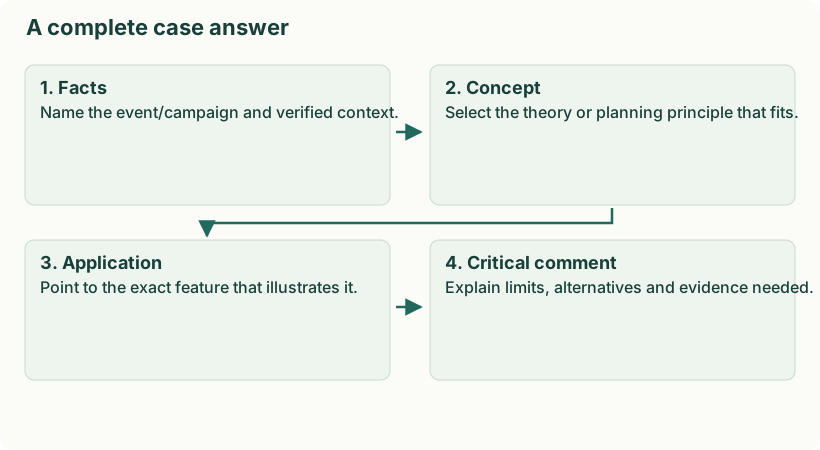
Diagram: A complete case answer. Labels: A complete case answer | A complete case answer | 1. Facts | Name the event/campaign and verified context. | 2. Concept | Select the theory or planning principle that fits. | 3. Application | Point to the exact feature that illustrates it. | 4. Critical comment | Explain limits, alternatives and evidence needed.