Advertising and Public Relations · TEE · papers
Q1A · Explain the Importance and Necessity of Communication
2024-07-04 · Semester VI re-exam
Actual TEE paper · 100 marks · Q1 compulsory + any four complete Q2–Q7
Q1 has four compulsory short parts totalling 20 marks; 5 marks per part is the equal preparation allocation where individual marks are not printed.
2024-07-04 · Q1A · Previous-paper question. Explain the Importance and Necessity of Communication. [5 marks]
Answer
Definition. Communication enables people and organisations to share meaning, coordinate action, build understanding and respond to feedback.
In simple words. Message bhejna enough nahi; shared meaning aur useful response chahiye.
Understand it step by step
- Inform: explain facts, features, conditions and instructions accurately.
- Coordinate: align staff, agencies and partners around the same purpose and promise.
- Persuade: offer reasons for a choice while respecting the audience’s ability to judge.
- Build relationships: listen as well as speak; concerns can reveal a service problem requiring action.
- Evaluate: distinguish sending a message from receiving and understanding it. Feedback closes that gap.
See it in use
Definition. Communication is the process through which a sender encodes a message, sends it through a channel and receives an interpreted response from an audience.
In simple words. Brand kuch kehna chahta hai; audience uska meaning samajhti hai. Beech ka medium aur noise result badal sakte hain.
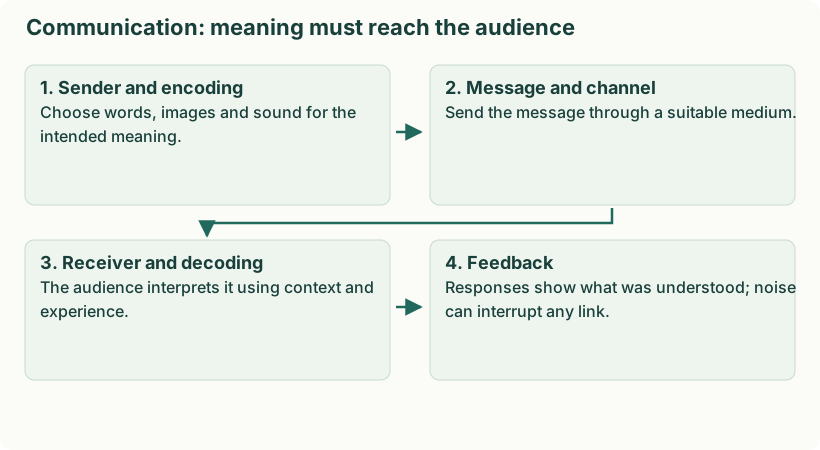
Diagram: Communication: meaning must reach the audience. Labels: Communication: meaning must reach the audience | Communication: meaning must reach the audience | 1. Sender and encoding | Choose words, images and sound for the | intended meaning. | 2. Message and channel | Send the message through a suitable medium. | 3. Receiver and decoding | The audience interprets it using context and | experience. | 4. Feedback | Responses show what was understood; noise | can interrupt any link.
Understand it step by step
- Sender: the organisation communicates a purpose, such as introducing a refill bottle. Encoding converts that purpose into words, pictures and sound.
- Message and medium: the message is the meaning; the medium carries it. “Refill to reduce packaging” is a message; a newspaper or video platform is a medium.
- Receiver and decoding: the audience interprets the signs using language, experience and context. A technical word can be understood differently by different groups.
- Noise and feedback: clutter, poor sound, confusing wording or distrust can interrupt meaning. Questions, recall research and responses help the sender assess what was understood.