Advertising and Public Relations · TEE · papers
Q6B · Illustrate the Stages of Media Planning
2024-07-04 · Semester VI re-exam
Actual TEE paper · 100 marks · Q1 compulsory + any four complete Q2–Q7
2024-07-04 · Q6B · Previous-paper question. Illustrate the Stages of Media Planning. [10 marks]
Answer
Definition. The media-plan process moves from market analysis to objectives, strategy implementation and evaluation.
In simple words. Pehle data, phir target, phir execution, phir result check.
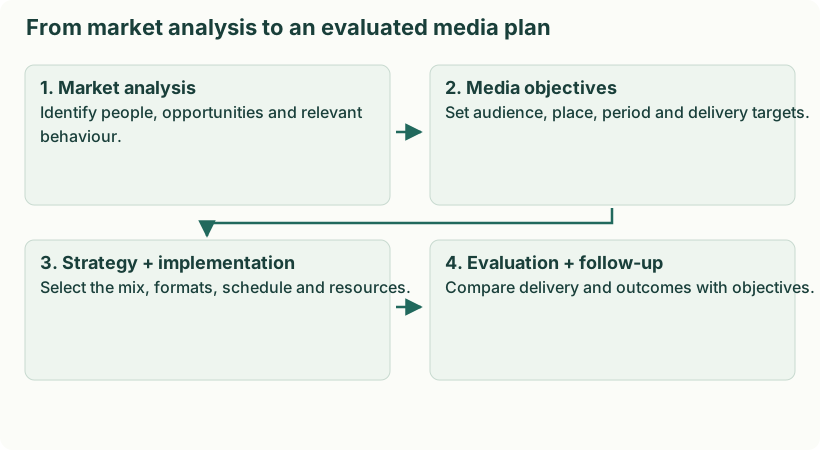
Understand it step by step
- 1. Analyse the market: identify audience opportunities, competition, geography and the source of business.
- 2. Establish media objectives: specify whom to reach, where, within what period and with what exposure level. Include the budget constraint.
- 3. Develop and implement: select a media mix, vehicles, formats and schedule; arrange creative production and buying.
- 4. Evaluate and follow up: compare actual reach, frequency, cost and quality with planned delivery, and examine contribution to awareness or other communication outcomes.
- Interpretation: a plan can meet its impression target but fail its communication objective if the message is confusing or the audience is wrong.
See it in use
The four stages, with the decision made at each stage
Media planning turns a marketing and communication brief into a delivery plan. Each stage produces information needed by the next. The museum example below is a hypothetical teaching plan; the targets are chosen for explanation, not copied from a past paper.
1. Market analysis and target-market identification
Examine the product or service, the market, competitors and the audience. Identify the people the campaign must reach, their location, needs and media habits. Distinguish the total market from the selected target. The output is a supported audience description and an understanding of the communication problem.
Example: a museum wants nearby college students to know about a weekend programme. Research must establish which colleges can realistically attend, the travel constraints and which channels those students use. Buying nationwide exposure would waste much of a local programme’s budget.
2. Establish media objectives
Specify whom to reach, where, during what period, with what intended reach and repetition, within the available budget. Media objectives describe delivery; marketing objectives concern outcomes such as registrations or sales. Both matter, but exposure is not proof of a sale.
Example: aim to reach 60% of the defined nearby student audience during four weeks, with an appropriate repetition target. Record how reach will be estimated, so results can be evaluated against the same audience and period.
3. Develop and implement the media strategy
Choose a suitable combination of media and specific vehicles, allocate the budget, schedule placements and arrange execution. Consider audience fit, geographic coverage, message format, reach, frequency, timing, flexibility and cost. Coordinate the creative material with placement specifications and check that bookings run as agreed.
Example: combine approved college notices with geographically relevant digital placements. Begin before registration closes, use consistent event details and ensure every booking link reaches the correct information. The choice must follow audience evidence rather than the popularity of a platform.
4. Evaluation and follow-up
Compare actual delivery with the objectives: placements delivered, target reach, repeated exposures, cost and timing. Examine audience understanding and registrations separately to assess contribution to communication and marketing goals. Identify gaps and adjust later activity; do not claim that every registration was caused by one advertisement.
Example: if many impressions reach people outside the local area, refine the placements. If students see the message but misunderstand the date, revise the creative. Evaluation therefore diagnoses the problem rather than treating a large impression total as automatic success.