Advertising and Public Relations · TEE · papers
Q7 · Discuss the Case Study of Jio’s Market Entry by explaining: (i) Background of the case study (ii) PR strategy (iii) Outcome
2024-07-04 · Semester VI re-exam
Actual TEE paper · 100 marks · Q1 compulsory + any four complete Q2–Q7
2024-07-04 · Q7 · Previous-paper question. Discuss the Case Study of Jio’s Market Entry by explaining: (i) Background of the case study (ii) PR strategy (iii) Outcome. [20 marks]
Answer
1. Background and communication problem
2. Strategy and application of concepts
- Background: A new telecom offering needs awareness, a clear proposition and workable customer access. Launch communication must explain the service and conditions.
- Trial strategy: An introductory offer can lower the barrier to trying a service. The resulting trial must be distinguished from sustainable paid retention.
- Publicity and information: A major launch creates opportunities for news attention. Accurate announcements and clear customer information help explain what is offered and how to access it.
- Marketing-mix integration: Network/service capability, the offer’s price conditions, distribution/onboarding and communication interact. Publicity without usable service would not produce the same experience.
- Different publics: Potential users need eligibility and usage information; retailers need onboarding guidance; employees need consistent answers; other stakeholders have different concerns.
- Evaluation: Separate reported acquisition, active use, satisfaction, later retention and business performance. Use the objective to choose the appropriate measure.
3. Outcome and what the evidence permits
Jio reported substantial early acquisition. The defensible classroom lesson is the interaction of a trial proposition, access, communication and service capacity—not that media attention alone created every customer.
4. Critical comments
- A rapid acquisition figure does not prove profitability, satisfaction or PR-only causation.
- State the historical date and offer context; do not present a 2016 launch offer as current.
- Clear conditions and service support matter because mass interest can create operational pressure.
5. Conclusion
The case is useful because it connects a defined audience need with a recognisable message and supporting action. A strong exam answer explains those connections and separates observed facts from assumptions about impact.
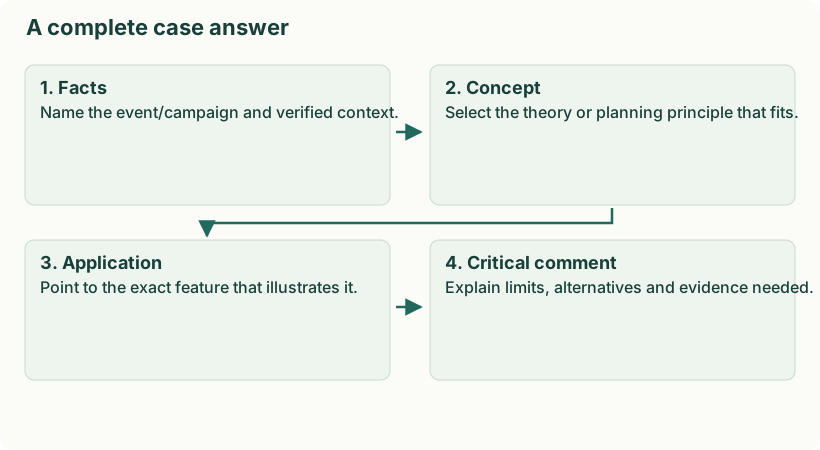
Diagram: A complete case answer. Labels: A complete case answer | A complete case answer | 1. Facts | Name the event/campaign and verified context. | 2. Concept | Select the theory or planning principle that fits. | 3. Application | Point to the exact feature that illustrates it. | 4. Critical comment | Explain limits, alternatives and evidence needed.