Advertising and Public Relations · TEE · papers
Q7 · Discuss the Case Study of ITC for its Business Strategy by explaining the following: (i) Completely discuss the case study. (ii) Interpret the important principles of marketing campaign, which helped to increase the sales and reputation of the brand, with your critical comments on the case study
2024-12-11 · Semester V final / re-exam
Actual TEE paper · 100 marks · Q1 compulsory + any four complete Q2–Q7
2024-12-11 · Q7 · Previous-paper question. Discuss the Case Study of ITC for its Business Strategy by explaining the following: (i) Completely discuss the case study. (ii) Interpret the important principles of marketing campaign, which helped to increase the sales and reputation of the brand, with your critical comments on the case study. [20 marks]
Answer
1. Background and communication problem
2. Strategy and application of concepts
- Corporate versus product brands: The corporate identity connects the organisation’s broader reputation. Individual product brands can hold category-specific positions for different customer needs.
- Segmentation: Food, personal-care and stationery customers do not all seek the same benefits. Each category needs audience research and a relevant message rather than one undifferentiated corporate slogan.
- Capabilities and differentiation: Research, production, supply relationships and distribution can support a differentiated promise. The reason to believe must come from the actual offering, not simply the size of the parent company.
- Marketing mix: Portfolio strategy requires product development, pricing, access and communication. Advertising builds awareness and meaning, while operations enable the promised experience.
- Integration: Shared organisational strengths can support multiple categories, but each brand still needs a clear identity and positioning. Extensions should be assessed for fit rather than assumed to succeed.
- Critical evaluation: Compare the intended benefits with customer evidence, category performance and costs. A diversified portfolio spreads activity across businesses but also adds managerial complexity.
3. Outcome and what the evidence permits
The evidence establishes the portfolio and described capabilities. It permits analysis of branding and marketing integration; it does not prove a particular campaign’s incremental sales.
4. Critical comments
- Do not present the current business list as if every business had the same structure in an older exam year.
- The supplied question does not identify a specific campaign. This is a portfolio-strategy analysis based on verified corporate information, not a reconstruction of an unavailable classroom case.
- Brand growth cannot be attributed solely to promotion while ignoring acquisitions, distribution and category demand.
5. Conclusion
The case is useful because it connects a defined audience need with a recognisable message and supporting action. A strong exam answer explains those connections and separates observed facts from assumptions about impact.
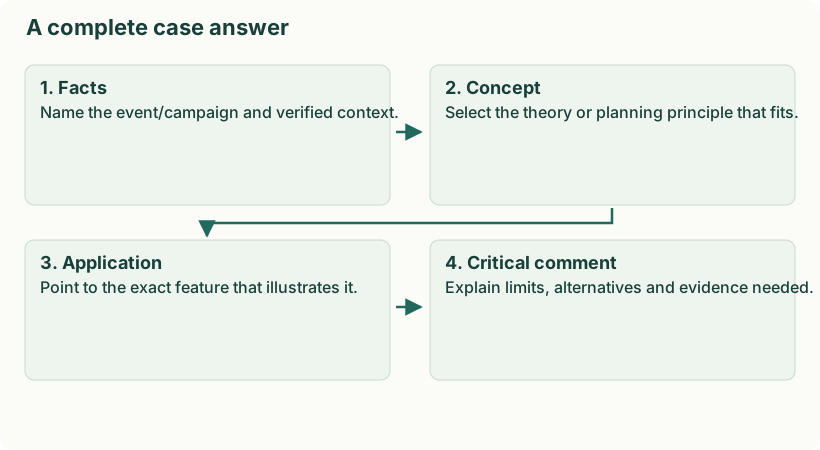
Diagram: A complete case answer. Labels: A complete case answer | A complete case answer | 1. Facts | Name the event/campaign and verified context. | 2. Concept | Select the theory or planning principle that fits. | 3. Application | Point to the exact feature that illustrates it. | 4. Critical comment | Explain limits, alternatives and evidence needed.