Advertising and Public Relations · TEE · papers
Q6B · Illustrate the concepts—Reach, Frequency and Message Weight—with appropriate examples
2025-02-25 · Semester V re-exam
Actual TEE paper · 100 marks · Q1 compulsory + any four complete Q2–Q7
2025-02-25 · Q6B · Previous-paper question. Illustrate the concepts—Reach, Frequency and Message Weight—with appropriate examples. [10 marks]
Answer
Reach, coverage, frequency and effective reach
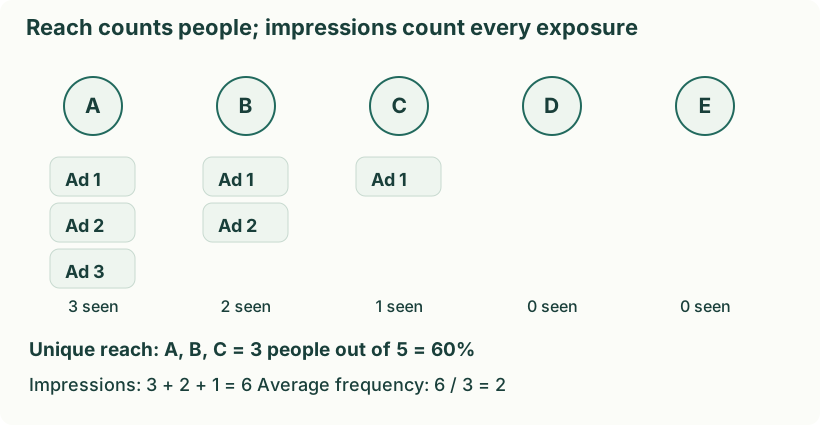
Definition. Reach counts distinct people exposed at least once during a defined period. Frequency measures repeated exposures. Coverage describes the potential audience accessible through a medium or plan.
In simple words. Reach mein banda ek baar count; impressions mein har exposure count.
Understand it step by step
- Universe: first define the entire target audience and period. “60% reach” is meaningless without saying 60% of whom and over what duration.
- Unduplicated reach: a person exposed five times contributes one person to reach, not five. Overlap between media must be removed.
- Average frequency: divide total exposures by the number reached. It is an average among reached people; it need not be an integer.
- Effective reach: the percentage meeting a specified exposure threshold, for example at least three opportunities. The threshold is part of the plan, not a universal law.
- Attention and outcome: an opportunity to see is not proof of noticing, remembering or purchasing. Excess repetition may waste resources or create fatigue.
 LaTeX:
\text{Reach \%}=\frac{\text{unique people reached}}{\text{target population}}\times100 LaTeX:
\bar f=\frac{\text{gross exposures}}{\text{unique people reached}}Continue to three complete reach / overlap examples →
See it in use
Gross impressions, rating and GRP
Definition. Gross impressions count all exposures, including repetitions. A rating expresses an audience as a percentage of a defined universe. Gross rating points sum rating points across insertions or equal reach percentage multiplied by average frequency for the same audience and period.
In simple words. Gross = repeat bhi count. GRP unique logon ka percent nahi hai.
Understand it step by step
- Impressions: if 2,000 people each have three exposures, they create 6,000 gross exposures. They still represent 2,000 unique people.
- Rating: divide the audience of a programme or insertion by its relevant universe and multiply by 100. Check whether the figure refers to people or households.
- GRP: multiply reach expressed as a percentage number, such as 60, by average frequency. 60 × 4 = 240 GRPs; do not use 0.60 in that version of the formula.
- Consistency: the reach-frequency formula requires matched target definition and period. Do not mix household ratings with person-based reach.
- Interpretation: GRP can exceed 100 because it counts repeated opportunities, not a population share. A high total does not prove unique reach or effectiveness.
 LaTeX:
\text{GRP}=R_{\%}\times\bar f LaTeX:
\text{Gross impressions}=\sum_i n_i f_iSee it in use
Worked examples for the requested measures
The original paper supplies no figures. The 16 May 2026 Q4(a) explicitly asks for examples showing calculations; the examples below use the faculty M2 notes pp27–28. State the assumptions and interpret each measure. CPM is not part of this question.
1. Reach: 3,000 distinct people out of 10,000
Given
| Quantity | Value |
|---|---|
| Unique people reached | 3,000 |
| Target population | 10,000 |
| Period | One month |
To find
Percentage of the target reached at least once.
Formula and why
 LaTeX:
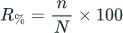
R_{\%}=\frac{n}{N}\times100Here n is the distinct people reached and N is the whole target. Divide part by whole, then multiply by 100.
Step-by-step solution
Step 1. Substitute the two counts
 LaTeX:
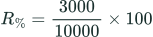
R_{\%}=\frac{3000}{10000}\times100Step 2. Divide to obtain the share
 LaTeX:
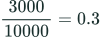
\frac{3000}{10000}=0.3Step 3. Convert the share to a percentage
 LaTeX:
0.3\times100=30\%Final answer: 30% reach.
2. Average frequency: two distinct audience groups
Given
| Group | Distinct people | Exposures each |
|---|---|---|
| 1 | 1500 | 3 |
| 2 | 1500 | 6 |
To find
Gross exposures, unduplicated reach and average frequency.
Formula and why
 LaTeX:
I=\sum_i n_i f_i,\qquad n=\sum_i n_i,\qquad\bar f=\frac{I}{n}Multiply each group size by its frequency; then add. The reach sum is valid because the question explicitly says the groups do not overlap.
Step-by-step solution
Step 1. Count exposures for group 1
 LaTeX:
1500\times3=4500Step 2. Count exposures for group 2
 LaTeX:
1500\times6=9000Step 3. Add all group exposures
 LaTeX:
4500+9000=13500Step 4. Count distinct people
 LaTeX:
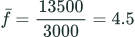
1500+1500=3000Step 5. Divide exposures by people reached
 LaTeX:
\bar f=\frac{13500}{3000}=4.5Final answer: Gross exposures = 13,500; reach = 3,000 people; average frequency = 4.5.
3. Message weight: gross impressions
Given
| Group | Distinct people | Exposures each |
|---|---|---|
| 1 | 6000 | 5 |
| 2 | 6000 | 7 |
| 3 | 3000 | 3 |
To find
Gross exposures, unduplicated reach and average frequency.
Formula and why
LaTeX: I=\sum_i n_i f_i,\qquad n=\sum_i n_i,\qquad\bar f=\frac{I}{n}Multiply each group size by its frequency; then add. The reach sum is valid because the question explicitly says the groups do not overlap.
Step-by-step solution
Step 1. Count exposures for group 1
 LaTeX:
6000\times5=30000Step 2. Count exposures for group 2
 LaTeX:
6000\times7=42000Step 3. Count exposures for group 3
 LaTeX:
3000\times3=9000Step 4. Add all group exposures
 LaTeX:
30000+42000+9000=81000Step 5. Count distinct people
 LaTeX:
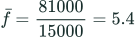
6000+6000+3000=15000Step 6. Divide exposures by people reached
 LaTeX:
\bar f=\frac{81000}{15000}=5.4Final answer: Gross exposures = 81,000; reach = 15,000 people; average frequency = 5.4.
4. Message weight: gross rating points
Given
| Reach | Average frequency | Target |
|---|---|---|
| 75% | 5.4 | 20000 |
To find
GRP, reached people and impressions.
Formula and why
 LaTeX:
\text{GRP}=R_{\%}\bar f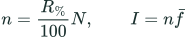 LaTeX:
n=\frac{R_{\%}}{100}N,\qquad I=n\bar fUse the percentage number in GRP. Divide it by 100 when finding a fraction of the population.
Step-by-step solution
Step 1. Calculate GRP
 LaTeX:
75\times5.4=405\text{ GRPs}Step 2. Convert reach to a fraction
 LaTeX:
75\div100=0.75Step 3. Calculate unique people reached
 LaTeX:
0.75\times20000=15000Step 4. Calculate gross impressions
 LaTeX:
15000\times5.4=81000Final answer: 405 GRPs; 15,000 people; 81,000 gross impressions.