Advertising and Public Relations · TEE · papers
Q7 · Discuss the Case Study of Amul during COVID 19 by explaining the following: (i) Completely discuss the case study. (ii) Interpret the important principles of marketing campaign, which helped to increase the sales and reputation of the brand, with your critical comments on the case study
2025-02-25 · Semester V re-exam
Actual TEE paper · 100 marks · Q1 compulsory + any four complete Q2–Q7
2025-02-25 · Q7 · Previous-paper question. Discuss the Case Study of Amul during COVID 19 by explaining the following: (i) Completely discuss the case study. (ii) Interpret the important principles of marketing campaign, which helped to increase the sales and reputation of the brand, with your critical comments on the case study. [20 marks]
Answer
1. Background and communication problem
2. Strategy and application of concepts
- Context: A major disruption changes customer concerns and access to essential goods. A relevant communication plan must begin with those practical needs rather than recycle a normal promotional calendar unchanged.
- Stakeholders: Milk producers, logistics teams, retailers, consumers and authorities need coordinated but different information. Supply-chain communication is part of fulfilling the promise made to the public.
- Availability and trust: If a brand communicates reliability, continued availability is the supporting action. The marketing lesson is the relationship between place/distribution and reputation, not merely the volume of advertising.
- Message relevance: Communication during a crisis should be useful, sensitive and factually supportable. Familiar identity can help recognition, but topical creative should not trivialise suffering.
- Integrated response: Align internal instructions, retail information, public messages and customer support so that the audience does not receive conflicting claims.
- Evaluation: Assess service availability, stakeholder understanding and customer concerns separately from media reach. A change in sales during a disruption may also reflect category demand and competitor availability.
3. Outcome and what the evidence permits
The verified case supports the principle that operational continuity can make a reliability message credible. The exact classroom case narrative is not attached, so these are verified anchors and a reasoned answer, not a claimed reproduction of that missing narrative.
4. Critical comments
- Do not invent a fixed advertising-spend increase or attribute a turnover change entirely to advertising.
- A company’s positive account is one perspective. Independent performance assessment requires additional operational and customer evidence.
- A topical ad and a continuity-of-supply programme are distinct activities; explain their relationship rather than treating them as identical.
5. Conclusion
The case is useful because it connects a defined audience need with a recognisable message and supporting action. A strong exam answer explains those connections and separates observed facts from assumptions about impact.
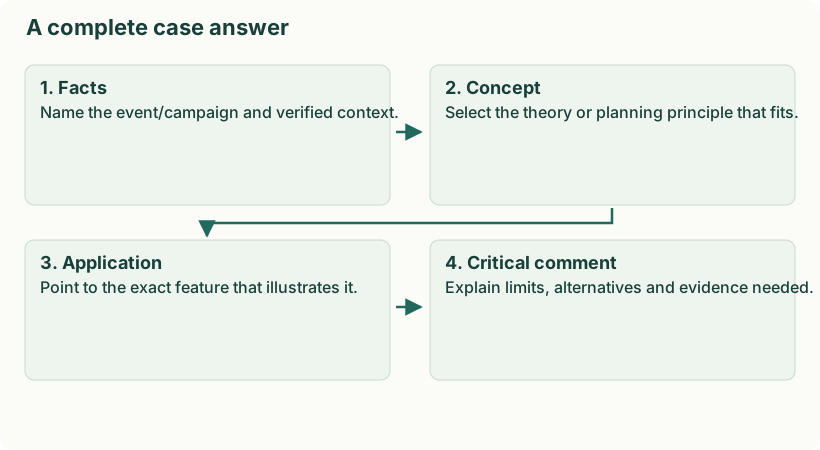
Diagram: A complete case answer. Labels: A complete case answer | A complete case answer | 1. Facts | Name the event/campaign and verified context. | 2. Concept | Select the theory or planning principle that fits. | 3. Application | Point to the exact feature that illustrates it. | 4. Critical comment | Explain limits, alternatives and evidence needed.