Advertising and Public Relations · TEE · papers
Q4B · Analyse the ‘AIDA’ and ‘Ehrenberg (ATRN)’ Models of advertising by giving appropriate examples
2025-12-11 · Final examination
Actual TEE paper · 100 marks · Q1 compulsory + any four complete Q2–Q7
2025-12-11 · Q4B · Previous-paper question. Analyse the ‘AIDA’ and ‘Ehrenberg (ATRN)’ Models of advertising by giving appropriate examples. [10 marks]
Answer
AIDA: attention → interest → desire → action
Definition. AIDA is a response-hierarchy model that organises persuasive communication into Attention, Interest, Desire and Action.
In simple words. Pehle notice, phir interest, phir chahiye, phir action.
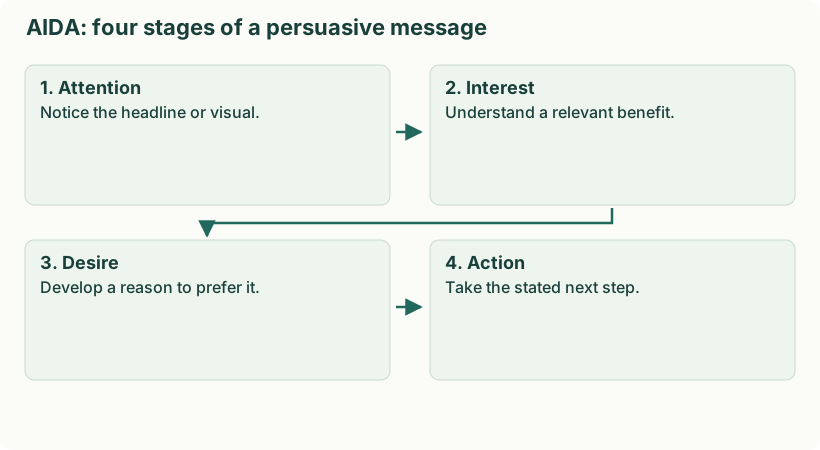
Understand it step by step
- Attention: earn notice with a relevant headline or visual. The notes also use “Awareness” for this first stage; explain that the message must first be noticed and recognised.
- Interest: offer information that matters to the audience. A striking image without a relevant benefit may stop here.
- Desire: connect the benefit to the person’s need and provide reasons to prefer the offering. Interest is “this is useful”; desire is “I would like this”.
- Action: give a clear next step: visit, enquire, register or purchase. Make access easy and avoid inventing false urgency.
- Limit: AIDA is a planning model, not a guarantee that every buyer follows a strict linear sequence. Habit and repeated experience may produce a different journey.
See it in use
One advertisement explained at all four stages
| Stage | Communication task | Illustrative beginner-workshop advertisement |
|---|---|---|
| Attention | Make the intended audience notice the message. | A readable headline, “Build your first website”, and a clear example page catch the attention of students interested in creating a site. |
| Interest | Give relevant information that makes the audience continue considering the offer. | Explain that the workshop covers page structure, styling and publishing, and state the date and beginner prerequisites. |
| Desire | Turn interest into a personal reason to prefer or want the offering. | Show what a student can realistically complete with guided support and explain why that outcome is useful. Evidence and credible scope support preference. |
| Action | Make the next response clear and practical. | Give the registration link, fee, deadline and contact details. The next action is registration; exposure alone is not action. |
Interest versus desire: “I want to know what is taught” is interest; “this suitable workshop would help me make my own site” is desire. A persuasive message should not skip essential conditions just to attract attention. Buyers may move back and forth or act from habit, so AIDA is a planning framework rather than a universal prediction.
Ehrenberg: awareness, trial, reinforcement and nudging
Definition. The course’s Ehrenberg model describes advertising through Awareness, Trial, Reinforcement and Nudging, particularly for established or frequently purchased brands.
In simple words. Naam pata → ek baar try → experience se bharosa → gentle reminder.
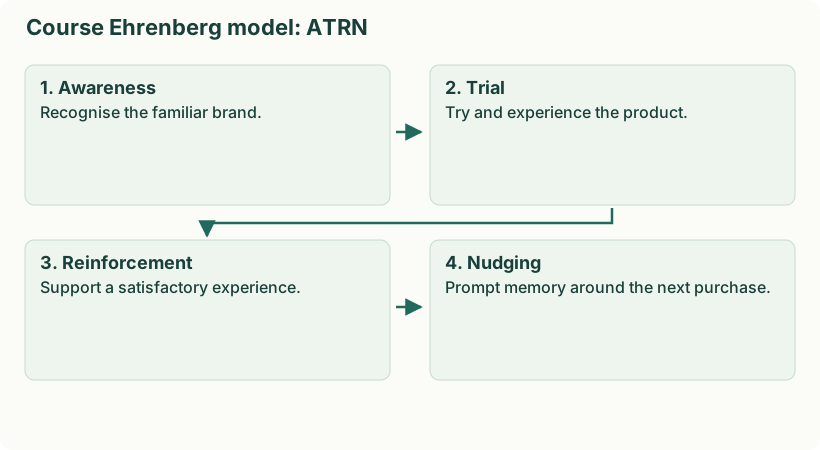
Understand it step by step
- Awareness: make the brand available in memory and easy to recognise.
- Trial: encourage an initial purchase or use. The customer learns from experience.
- Reinforcement: remind the user of a satisfactory experience and strengthen the existing choice. Advertising cannot create genuine product satisfaction by assertion alone.
- Nudging: keep the brand easy to recall near another purchase. This is the fourth classroom label in the supplied notes; other accounts often abbreviate the framework to ATR.
- Contrast: strong hierarchy models emphasise persuasive movement in attitudes before action. Ehrenberg’s weaker view gives a substantial role to trial, habit and reinforcement.