Advertising and Public Relations · TEE · papers
Q6B · Summarize the ‘Steps Involved in Review of a Marketing Plan’ before strategic planning
2025-12-11 · Final examination
Actual TEE paper · 100 marks · Q1 compulsory + any four complete Q2–Q7
2025-12-11 · Q6B · Previous-paper question. Summarize the ‘Steps Involved in Review of a Marketing Plan’ before strategic planning. [10 marks]
Answer
Definition. A marketing-communication brief summarises the market and business problem so that the advertising supports the overall marketing plan.
In simple words. Ad banane se pehle business ki actual problem samjho.
Understand it step by step
- Product description: explain the offering clearly to someone unfamiliar with it. Separate a feature from the benefit it produces.
- Market assessment: examine category trends, competitors, audience research and distribution. Use current evidence rather than an old assumption.
- Source of business: decide whether growth should come from new category users, competitor users or increased use by existing customers.
- Marketing objectives: specify the sales, share or usage change sought and the resources available. A communication objective must support this business objective.
- Briefing document: summarise these inputs for the creative and media teams. The notes say “five areas” but list four numbered review areas; learn the four supplied headings rather than invent a missing fifth.
See it in use
What the four review areas contribute to the advertising brief
| Faculty review area | Questions to resolve | Illustrative reusable-bottle plan |
|---|---|---|
| Product description | What is offered, what does it do, and which benefit can be substantiated? | State capacity, material and care instructions; connect reusability to the user’s actual refill routine. Do not claim a health or environmental benefit without supporting evidence. |
| Market assessment | Who buys the category, what alternatives exist, and what practical conditions affect demand? | Study students’ existing bottles, prices, refill access and competitor offerings. Availability of safe refill points affects usefulness. |
| Source of business | Will growth come from new category users, switching users or greater use by existing customers? | A campaign for students without a reusable bottle needs a different reason to try than one asking existing users to switch brands. |
| Marketing objectives | What business change is sought, in which market and period, with what resources? | Specify a realistic trial or sales objective for a defined campus launch. Then set supporting communication and media objectives. |
The brief communicates these conclusions to the creative and media teams. It is an output of the review, not a fabricated fifth numbered area. Review the marketing plan before choosing messages and media so the campaign supports the actual business problem.
Wording and scheme mismatch
The question says review of the marketing plan, but its scheme refers to five strategic steps. The review above answers the printed wording; the five strategic steps below cover the scheme’s additional expectation.
Definition. Strategic advertising planning connects a business objective to a selected audience, relevant position, communication objective and media delivery.
In simple words. Kisko → decision kaise → brand ka place → kya message → kahan dikhana.
Understand it step by step
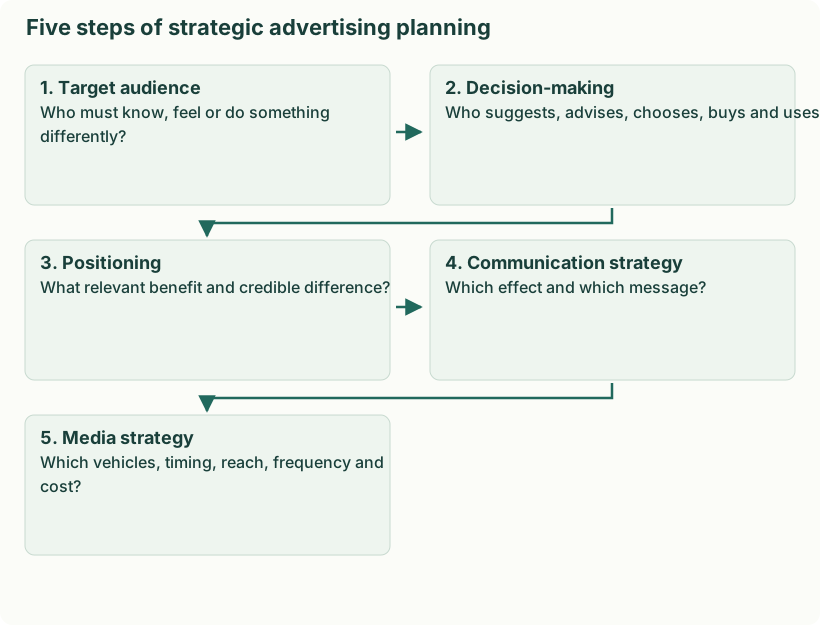
- 1. Select the target audience: choose the group whose behaviour matters to the marketing objective.
- 2. Understand decision-making: identify roles, perceived risk, motivation and barriers.
- 3. Determine positioning: select the category frame, relevant benefit and reason to believe.
- 4. Develop communication strategy: decide the desired change in category need, awareness, attitude or intention and shape the message.
- 5. Set media strategy: choose vehicles, timing, reach and frequency that enable the intended audience to process the message.
See it in use
Develop the five steps as one connected plan
The marketing-plan review supplies the starting problem, product information, market assessment and business objective. The five steps then turn this brief into communication decisions. Each step produces an output used by the next; choosing a medium before understanding the audience can waste the budget.
Step 1. Select the target audience
Identify whose action is needed: category newcomers, competing-brand users, existing customers or intermediaries. Describe the group using relevant location, behaviour, needs and other evidence. Distinguish a trial objective from repeat purchase: someone who has never used the brand needs a reason to try, while an existing user may need reinforcement or a new usage occasion. The output is a clear audience profile, not “everyone”.
Step 2. Understand how that audience decides
Identify the initiator, influencer, decider, purchaser and user; these roles can overlap. Examine involvement, perceived risk, motivation and obstacles. A costly unfamiliar purchase needs more reassurance than a familiar routine purchase. Ask what information or experience would reduce the relevant barrier. The output is an explanation of how the audience chooses and what prevents the desired action.
Step 3. Determine the best positioning
Specify the category in which the offering competes, the important benefit for the selected audience and a credible reason to believe it. Positioning concerns the intended place in the audience’s mind relative to alternatives. A feature matters when its practical benefit is clear. Avoid choosing an attractive promise that the service cannot deliver. The output is a consistent position that guides the message and customer experience.
Step 4. Develop the communication strategy
Decide whether the immediate task concerns category need, brand awareness, brand attitude or purchase intention. Set an appropriate objective and then choose the main message, supporting evidence, appeal, tone and response requested. Awareness is not the same as sales: people may recognise a name without trusting it or being able to buy. The output is a communication brief that explains what the audience should understand, feel or intend and why.
Step 5. Set the media strategy
Select channels and specific vehicles that reach the target group in a suitable context. Decide timing, scheduling, geographic coverage, reach, frequency and budget. A demonstration needs a format that can show the process; a detailed comparison needs enough reading or viewing time. Repeated exposure may help recognition but cannot guarantee persuasion. The output is a delivery plan with measures related to the communication objective.
Evaluation closes the planning loop
Check delivery, communication effects and business results separately. If many students see the message but still misunderstand the estimate process, improve the explanation. If understanding improves but access is inconvenient, advertising alone will not fix the operational problem. Evaluation is feedback on the five-step plan, not an invented sixth item in the course’s named model.