Advertising and Public Relations · TEE · papers
Q3B · Explain the concept of ‘Public Relations along with the various steps of ‘PR Process.’
2026-05-16 · Final examination
Actual TEE paper · 100 marks · Q1 compulsory + any four complete Q2–Q7
2026-05-16 · Q3B · Previous-paper question. Explain the concept of ‘Public Relations along with the various steps of ‘PR Process.’ [10 marks]
Answer
Definition. The PR process uses evidence to identify a relationship problem, plan a response, implement it and evaluate its effects.
In simple words. Pehle problem samjho; press release se seedha start mat karo.
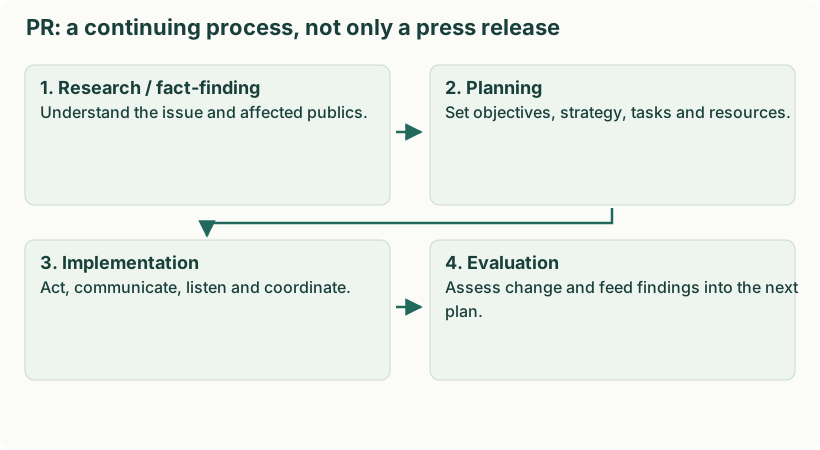
Understand it step by step
- Research: identify the issue, relevant publics, baseline understanding and organisational constraints. Use interviews, surveys, records and listening.
- Planning: set specific objectives, prioritise publics, choose strategy, messages, responsibilities, budget and evaluation measures.
- Implementation: carry out the planned actions and communication; brief spokespeople, coordinate channels and respond to feedback.
- Evaluation: distinguish outputs (what was produced), understanding/attitude effects and outcomes (what changed). Compare with the baseline and objective.
- Iteration: use findings to improve both organisational action and communication. The RACE labels—Research, Action planning, Communication, Evaluation—describe a closely related planning sequence.
See it in use
Definition. Public relations is a planned communication and management activity that develops understanding and relationships between an organisation and groups that affect or are affected by it.
In simple words. Publics matlab sirf customers nahi—employees, community, media sab relevant ho sakte hain.
Understand it step by step
- Identify publics: employees, customers, investors, suppliers, local communities, government and journalists have different interests.
- Listen and advise: research concerns and tell management when organisational behaviour, not merely wording, needs to change.
- Communicate and engage: explain decisions, answer questions and make dialogue possible.
- Build credibility: align statements with action over time. Reputation cannot be repaired sustainably with slogans alone.
- Evaluate: assess understanding, trust, relationship quality and relevant behaviour, rather than only counting media mentions.
See it in use
Course headings for PR objectives
- Identify the target publics and their needs.
- Set clear, measurable objectives for understanding, trust or behaviour.
- Analyse the context and relevant issues.
- Reach the right public through a suitable place and time.
- Adapt relevant content to feedback while maintaining factual consistency.
These headings, used in the December 2025 scheme, are planning requirements supporting PR objectives; an actual objective must still specify the change sought.