Advertising and Public Relations · TEE · papers
Q1D · Explain the concept of ‘Public Relations Campaign.’
2026-07-11 · Re-examination
Actual TEE paper · 100 marks · Q1 compulsory + any four complete Q2–Q7
The original paper does not print an individual mark for this part. The displayed 5 preparation marks are an inferred study allocation, not a printed mark.
2026-07-11 · Q1D · Previous-paper question. Explain the concept of ‘Public Relations Campaign.’ [5 preparation marks]
Answer
Definition. A PR campaign is a coordinated set of actions and communication directed at a defined relationship or public-interest/business problem over a stated period.
In simple words. Social ho ya commercial: objective, public, evidence aur evaluation clear.
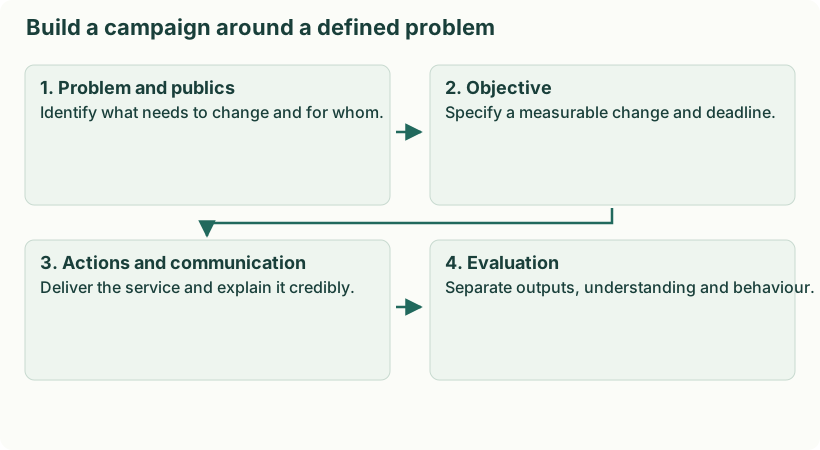
Diagram: Build a campaign around a defined problem. Labels: Build a campaign around a defined problem | Build a campaign around a defined problem | 1. Problem and publics | Identify what needs to change and for whom. | 2. Objective | Specify a measurable change and deadline. | 3. Actions and communication | Deliver the service and explain it credibly. | 4. Evaluation | Separate outputs, understanding and behaviour.
Understand it step by step
- Research and problem: define what is changing and why; identify barriers and what the organisation can actually do.
- Objective and publics: specify a measurable change, target group and timeframe. Social campaigns may seek safer or more inclusive behaviour; commercial campaigns may support trust, adoption or relationships.
- Strategy and messages: connect a credible benefit to the audience’s concern; ensure behaviour and services support the message.
- Activities: combine engagement, media relations, community partnerships, owned channels and appropriate advertising. Assign time, budget and responsibilities.
- Evaluation: measure understanding, attitudes and relevant outcomes. Keep campaign outputs separate from impact and avoid attributing all change to communication.
See it in use
Definition. The PR process uses evidence to identify a relationship problem, plan a response, implement it and evaluate its effects.
In simple words. Pehle problem samjho; press release se seedha start mat karo.
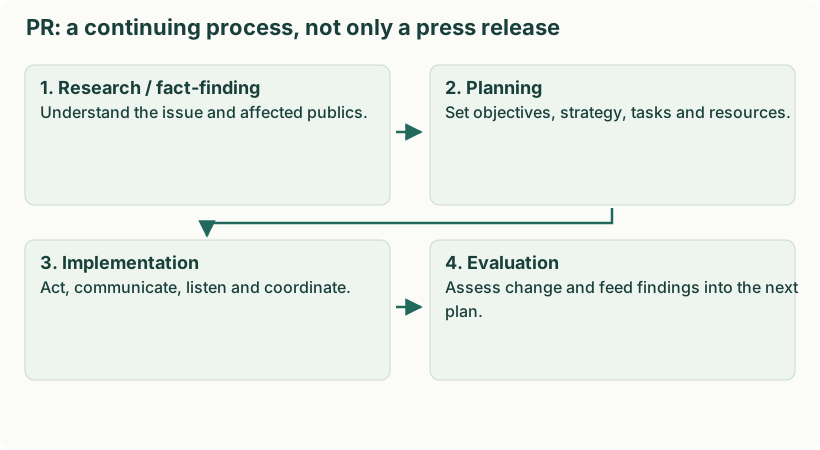
Diagram: PR: a continuing process, not only a press release. Labels: PR: a continuing process, not only a press release | PR: a continuing process, not only a press release | 1. Research / fact-finding | Understand the issue and affected publics. | 2. Planning | Set objectives, strategy, tasks and resources. | 3. Implementation | Act, communicate, listen and coordinate. | 4. Evaluation | Assess change and feed findings into the next | plan.
Understand it step by step
- Research: identify the issue, relevant publics, baseline understanding and organisational constraints. Use interviews, surveys, records and listening.
- Planning: set specific objectives, prioritise publics, choose strategy, messages, responsibilities, budget and evaluation measures.
- Implementation: carry out the planned actions and communication; brief spokespeople, coordinate channels and respond to feedback.
- Evaluation: distinguish outputs (what was produced), understanding/attitude effects and outcomes (what changed). Compare with the baseline and objective.
- Iteration: use findings to improve both organisational action and communication. The RACE labels—Research, Action planning, Communication, Evaluation—describe a closely related planning sequence.