Advertising and Public Relations · TEE · papers
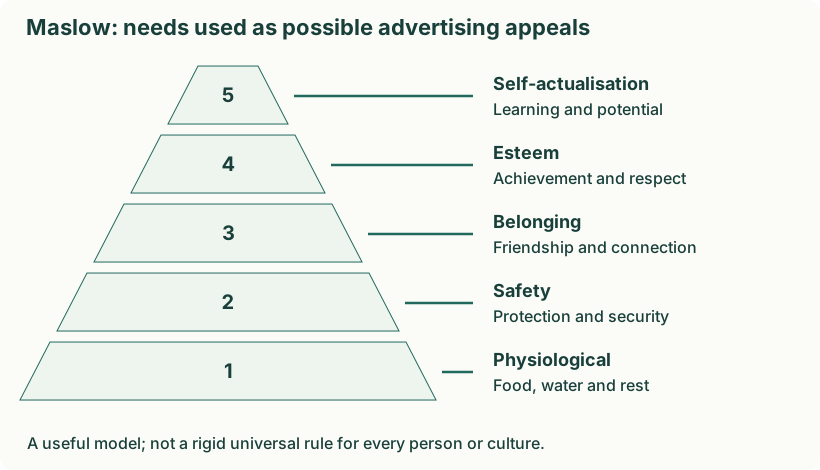
Q4B · Discuss the ‘Maslow’s Model of Hierarchy of Needs’ used as an advertising model with a sketch of Maslow’s pyramid for hierarchy of needs
2026-07-11 · Re-examination
Actual TEE paper · 100 marks · Q1 compulsory + any four complete Q2–Q7
2026-07-11 · Q4B · Previous-paper question. Discuss the ‘Maslow’s Model of Hierarchy of Needs’ used as an advertising model with a sketch of Maslow’s pyramid for hierarchy of needs. [10 marks]
Answer
Maslow: five types of needs used in advertising appeals
Definition. Maslow’s hierarchy groups human needs into physiological, safety, belongingness, esteem and self-actualisation needs. Advertisers may connect an offering to a relevant need.
In simple words. Ad dekhke pucho: kaunsi need ko appeal kar raha hai?
Understand it step by step
- Physiological: basic bodily needs such as food, water and rest. A water-service message can emphasise access to drinking water.
- Safety: security, protection and predictability. A helmet advertisement may emphasise tested protection, without guaranteeing that injury is impossible.
- Belonging: friendship, family and acceptance. The meaning is social connection.
- Esteem: respect, achievement and confidence. An appeal may link a product or service to recognition.
- Self-actualisation: developing capabilities and fulfilling personal potential. A creative course may invite the learner to develop a skill.
- Limit: the hierarchy is a useful interpretive model, not a universal rule requiring every lower need to be completely satisfied before another need matters.
See it in use
Connect each need to a different advertising appeal
| Need, from the base upward | Why the appeal fits | Illustrative message |
|---|---|---|
| Physiological | The offering is related to a basic bodily need such as food or water. | A drinking-water advertisement emphasises access to safe water and relief from thirst, using substantiated product claims. |
| Safety | The appeal addresses protection, stability or reduction of a relevant threat. | A tested protective helmet is advertised using its applicable safety certification and proper-use information; it does not promise zero injury. |
| Belongingness / social | The appeal connects the product or experience with relationships and inclusion. | A shared meal advertisement shows friends gathering and enjoying time together. The social meaning supports the appeal. |
| Esteem | The appeal concerns respect, recognition, achievement or self-confidence. | A professional-development programme highlights a learner’s demonstrated achievement and recognition, without guaranteeing promotion. |
| Self-actualisation | The appeal concerns developing one’s abilities, creativity or potential. | An art course encourages learners to develop their own creative work, rather than relying only on status or external praise. |
Draw and label the pyramid from physiological needs at the base to self-actualisation at the top. Then explain the motive, product connection and example for each level. One advertisement may appeal to several needs, and people do not always satisfy them in an inflexible order. Use the hierarchy to analyse an appeal; do not diagnose every buyer from one purchase.