Advertising and Public Relations · TEE · practice
The small amount of maths needed here
Optional numerical practice
Extra drills; no claim that these exact questions or allocated marks appeared in TEE
A percentage means “out of 100”. A ratio compares two quantities by division. A weighted total multiplies the size of each group by the amount contributed by each member. These three ideas cover the APR calculations.
| Operation | Meaning | Small example |
|---|---|---|
| Part ÷ whole × 100 | Convert a share to a percentage | 20 out of 80: 20 ÷ 80 = 0.25; 0.25 × 100 = 25% |
| Percentage ÷ 100 × whole | Recover a count | 25% of 80: 25 ÷ 100 × 80 = 20 |
| Group size × repetitions | Count every exposure | 20 people × 3 exposures = 60 impressions |
| Total exposures ÷ people reached | Average among people reached | 60 ÷ 20 = 3 exposures per reached person |
| Percentage-point change | Subtract percentage values | 40% − 20% = 20 percentage points |
Keep the time period and population consistent. A monthly person-based reach cannot be combined casually with a weekly household frequency. Round only the final answer when possible. On your calculator, put the denominator in brackets if it contains more than one operation.
Practice question. A campaign’s awareness rises from 20% to 40%. State the percentage-point increase and relative percentage increase. [2 practice marks]
Answer
Given
Initial awareness = 20%; final awareness = 40%.
To find
Absolute change in percentage points and relative change from the initial level.
Formula and why
 LaTeX:
\Delta_{\rm pp}=p_1-p_0,\qquad\text{relative increase}=\frac{p_1-p_0}{p_0}\times100Subtract the percentages for percentage points. Divide that difference by the starting percentage for relative change.
Step 1. Find the difference
 LaTeX:
40-20=20\text{ percentage points}Step 2. Divide by the baseline
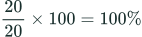 LaTeX:
\frac{20}{20}\times100=100\%Final answer: 20 percentage points; 100% relative increase.