Advertising and Public Relations · TEE · practice
Average frequency example 1
Optional numerical practice
Extra drills; no claim that these exact questions or allocated marks appeared in TEE
Faculty-note worked example. In a four-week campaign, 1,500 people receive 3 exposures each, 1,500 people receive 6 exposures each. The groups are distinct with no overlap. Find gross exposures, unique reach and average frequency. [3 practice marks]
Answer
Faculty-note worked example: the values come from APR M2 notes p27. The question has been rewritten to teach the steps; this is not verbatim PYQ wording. Any practice-mark allocation is author-set.
Given
| Group | Distinct people | Exposures each |
|---|---|---|
| 1 | 1500 | 3 |
| 2 | 1500 | 6 |
To find
Gross exposures, unduplicated reach and average frequency.
Formula and why
 LaTeX:
I=\sum_i n_i f_i,\qquad n=\sum_i n_i,\qquad\bar f=\frac{I}{n}Multiply each group size by its frequency; then add. The reach sum is valid because the question explicitly says the groups do not overlap.
Step-by-step solution
Step 1. Count exposures for group 1
 LaTeX:
1500\times3=4500Step 2. Count exposures for group 2
 LaTeX:
1500\times6=9000Step 3. Add all group exposures
 LaTeX:
4500+9000=13500Step 4. Count distinct people
 LaTeX:
1500+1500=3000Step 5. Divide exposures by people reached
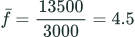 LaTeX:
\bar f=\frac{13500}{3000}=4.5Final answer: Gross exposures = 13,500; reach = 3,000 people; average frequency = 4.5.