Advertising and Public Relations · TEE · practice
BDI and CDI example 1
Optional numerical practice
Extra drills; no claim that these exact questions or allocated marks appeared in TEE
Optional practice question. An area contains 10% of the relevant population, accounts for 15% of total brand sales and 20% of total category sales. Calculate BDI and CDI and interpret them. [3 practice marks]
Answer
Authored illustration: these numbers were chosen to explain a faculty-note concept. No matching supplied-data question was found in the 14 recovered APR papers. Standalone calculation drills are optional practice; their marks are author-set.
Given
| Population share | Brand-sales share | Category-sales share |
|---|---|---|
| 10% | 15% | 20% |
To find
Brand and category development indices.
Formula and why
 LaTeX:
\text{BDI}=\frac{B_{\%}}{P_{\%}}\times100,\qquad\text{CDI}=\frac{C_{\%}}{P_{\%}}\times100The common denominator is population share. Only the numerator changes between brand sales and category sales.
Step-by-step solution
Step 1. Substitute for BDI
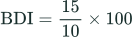 LaTeX:
\text{BDI}=\frac{15}{10}\times100Step 2. Divide and scale BDI
 LaTeX:
1.5\times100=150Step 3. Substitute for CDI
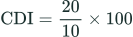 LaTeX:
\text{CDI}=\frac{20}{10}\times100Step 4. Divide and scale CDI
 LaTeX:
2\times100=200Step 5. Compare each with 100
Both brand and category are over-represented relative to population.
Final answer: BDI = 150; CDI = 200.