Advertising and Public Relations · TEE · read
Amul topical advertising: continuity with variation
Unit 5 · Real campaigns and case answers
Verified campaign facts + clearly identified teaching analysis
Use these facts as an anchor, then make a clear connection to the exact concept asked in the question. The analysis below is a teaching interpretation; it is not a claim that the advertiser formally chose a particular model.
| Aspect | Analysis |
|---|---|
| Identity | A recognisable brand presentation supplies continuity across changing topical messages. |
| Creative variation | The specific topical reference changes while the brand remains identifiable. |
| Theory/model link | Reminder and reinforcement functions can be discussed using DRIP and the course’s Ehrenberg framework. |
| Media/context | Understanding a topical reference depends on audience knowledge and timeliness. |
| Limitation | A humorous topical message may be noticed without communicating a detailed functional claim; decide whether that matches the objective. |
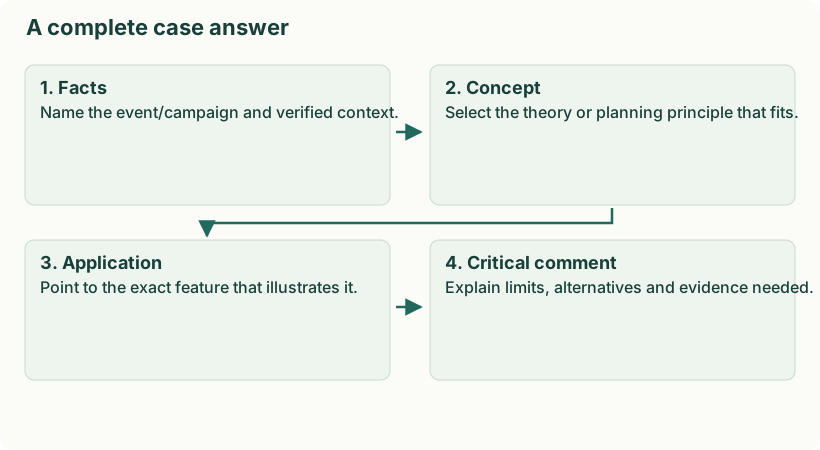
Diagram: A complete case answer. Labels: A complete case answer | A complete case answer | 1. Facts | Name the event/campaign and verified context. | 2. Concept | Select the theory or planning principle that fits. | 3. Application | Point to the exact feature that illustrates it. | 4. Critical comment | Explain limits, alternatives and evidence needed.
Practice question. Analyse Amul topical advertising as an advertising or PR case, connecting the message to relevant concepts. [10 practice marks]
Answer
- Identity: A recognisable brand presentation supplies continuity across changing topical messages.
- Creative variation: The specific topical reference changes while the brand remains identifiable.
- Theory/model link: Reminder and reinforcement functions can be discussed using DRIP and the course’s Ehrenberg framework.
- Media/context: Understanding a topical reference depends on audience knowledge and timeliness.
- Limitation: A humorous topical message may be noticed without communicating a detailed functional claim; decide whether that matches the objective.