Advertising and Public Relations · TEE · read
Worked draft 3: video script and storyboard
Unit 3.6 · Comparing media
M2 notes pp34–35; course-policy production exercises
An audio-visual answer must describe what the viewer sees and hears at each stage. A paragraph of narration alone is not a complete television/video script.
Practice question. Prepare a 20-second video advertisement for fictional CycleCare using a storyboard and timed visual/audio script. Demonstrate its estimate-before-repair policy and include a booking action. [10 practice marks]
Answer
Given
A 20-second video for fictional CycleCare. The benefit and response point are the same as in the print and radio exercises. The video must also remain understandable when viewed without sound.
To create
A storyboard and timed two-column visual/audio script. A shot is one continuous camera view; the storyboard arranges the planned shots in order.
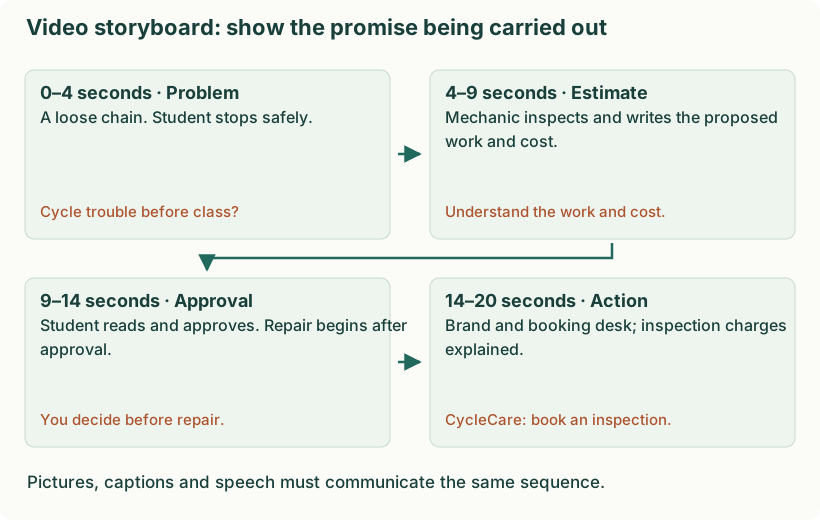
Step 1. Show the process rather than merely naming it
Step 2. Write the complete script
| Time | Visual action and on-screen text | Audio |
|---|---|---|
| 0–4 s | Close view of a loose cycle chain. Student stops safely beside the cycle. Text: “Cycle trouble before class?” | Short chain sound. VO: “Cycle trouble before class?” |
| 4–9 s | Mechanic inspects the chain and writes the proposed work on an estimate. Text: “Inspection. Explanation. Estimate.” | VO: “At CycleCare, understand the proposed work and cost.” |
| 9–14 s | Student reads the estimate and approves; only then does repair begin. Text: “Repair starts after your approval.” | VO: “You approve the estimate before repairs begin.” |
| 14–20 s | Brand and a clearly labelled service desk. Text: “CycleCare. Book at the campus cycle desk. Ask about inspection charges.” | VO: “CycleCare. Book at the campus cycle desk. Ask about inspection charges.” |
Step 3. Explain the link between picture and promise
The estimate is shown before the repair action. This order demonstrates the promised process. Reversing those two scenes would weaken or contradict the message. The final frame provides the brand and booking instruction; it should remain on screen long enough to read.
Step 4. Prepare for viewing and production
- Captions: provide legible speech captions and concise on-screen messages, so meaning does not depend solely on audio.
- Framing: keep the estimate and action text visible in the chosen aspect ratio; check a small phone screen.
- Sound: avoid music masking the voice-over.
- Timing: rehearse and edit to the stated duration. The storyboard is a plan, not a claim that a real repair takes 20 seconds.
Yaad rakho: Video = kya dikhega + kya sunai dega + kitne seconds; dono columns ka message same.