Advertising and Public Relations · TEE · revision
Unit 3 · strategy and media
Last-day TEE revision
All five units and case-answer structure
Use the following connected outline to revise. Open a topic for its full definition, explained points, diagram where useful and example.
What a brand is: identity, image and promise
A brand identifies and differentiates an offering using recognisable signs and accumulated associations. Identity is how the organisation intends to present the brand. Image is how audiences actually perceive it through communication and experience.
Brand management and its challenges
- Market fragmentation requires relevant messages for different needs.
- Media fragmentation makes consistent communication across many touchpoints harder.
- Informed buyers compare claims and experiences, making credibility and service quality essential.
The complete five-step strategic planning process
- Select an audience consistent with marketing objectives.
- Study how that audience makes the purchase decision.
- Define a relevant and distinctive brand position.
- Develop a message around specified communication effects.
- Select media and scheduling that deliver the message effectively within resources.
Developing and evaluating the media plan
- Analyse the market and identify the target audience.
- Set measurable media objectives for audience, place, timing and exposure.
- Develop and implement a suitable mix and schedule.
- Evaluate media delivery and its contribution to communication objectives; improve the next plan.
Print, audio, audio-visual and digital
Definition. A medium’s sensory and technical characteristics determine how a message can be presented and how audiences can respond.
| Medium | Nature | Strength | Limitation | Illustrative use |
|---|---|---|---|---|
| Text and still images; can be retained and reread | Detailed explanation; useful local or specialist targeting | No motion or sound; readership and placement matter | Magazine page explaining a product specification | |
| Audio | Speech, music, sound effects and silence | Voice and sound can create recall; fits listening occasions | No visual demonstration; listeners may miss details | Local radio announcement with a memorable spoken address |
| Audio-visual | Sight, motion and sound | Demonstrates use and combines verbal/nonverbal cues | Production and placement costs; clutter and avoidance | Film showing how a foldable product works |
| Digital | Can combine text, audio, video and interaction | Clickable response, flexible formats and measurable events | Privacy, fraud, clutter, measurement gaps and unequal access | Captioned demo linked to a detailed product page |
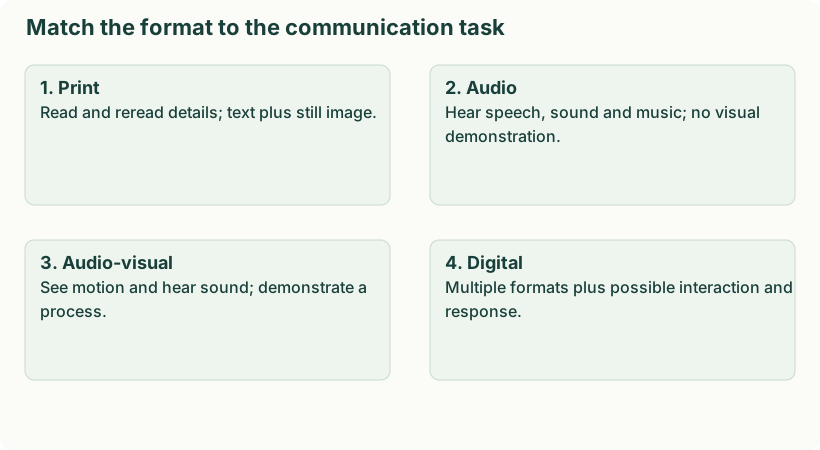
These categories can overlap: a digital video is both digital and audio-visual; a digital newspaper uses print-style text but online distribution. Print is not necessarily published only once a day. Electronic and digital are not exact opposites: radio and television can also use digital transmission.
Media measures: match the actual task
Be able to define reach, frequency and message weight, explain their importance and show one calculation for each. May 2026 Q4(a) asks exactly that. For BDI/CDI, explain both ratios and all four high/low interpretations; that is the July 2026 Q6(b) task. The paper does not supply a large numerical dataset.