Computer Networks · TEE · mocks
Q3A · Network classifications and topologies
TEE mock B · full paper
TEE · 100 attempted marks · solutions for every choice · current syllabus 702AI0C023
TEE practice mock · Q3A. Define network topology. Explain star and bus topologies with diagrams, advantages and disadvantages; compare ring and mesh. [5 mock marks]
Answer
Topology is the arrangement of nodes and links. Physical topology describes actual links; logical topology describes how data flows. A switch-centred physical star is different from a shared collision-domain bus.
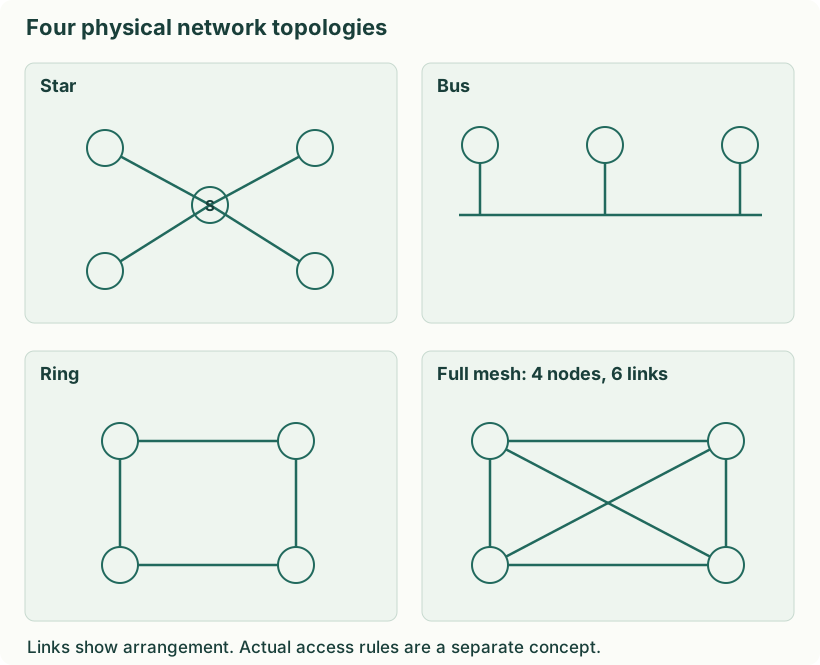
Diagram: Four physical network topologies. Labels: Four physical network topologies | Four physical network topologies | Star | Bus | Ring | Full mesh: 4 nodes, 6 links | S | Links show arrangement. Actual access rules are a separate concept.
| Topology | Structure | Benefit | Limitation |
|---|---|---|---|
| Bus | Devices share a common backbone | Simple small shared-medium layout | Backbone fault affects segment; collisions possible on classic shared bus |
| Star | Each device connects to a central switch/hub | Easy expansion and fault isolation | Central-device failure affects star; more cabling |
| Ring | Each node connected to two neighbours in a ring | Structured traversal; token-based variants coordinate access | Simple single-ring break can disrupt operation unless protected |
| Full mesh | Every pair has a direct link | Redundant paths and direct connectivity | Expensive ports/cabling: n(n−1)/2 undirected links |
| Tree/hybrid | Hierarchical stars or combined topologies | Scales into buildings/floors | Upper-level faults affect dependent branches |