Disaster Management · TEE · papers
Q4B · Discuss in detail any five mitigation measures for prevention of Landslides with neat…
2023-07-05 · Semester VI re-exam
Actual older TEE paper · 100 marks · Q1 compulsory; any four of Q2–Q7
Q4B. Discuss in detail any five mitigation measures for prevention of Landslides with neat sketches as applicable. [10 marks]
Answer
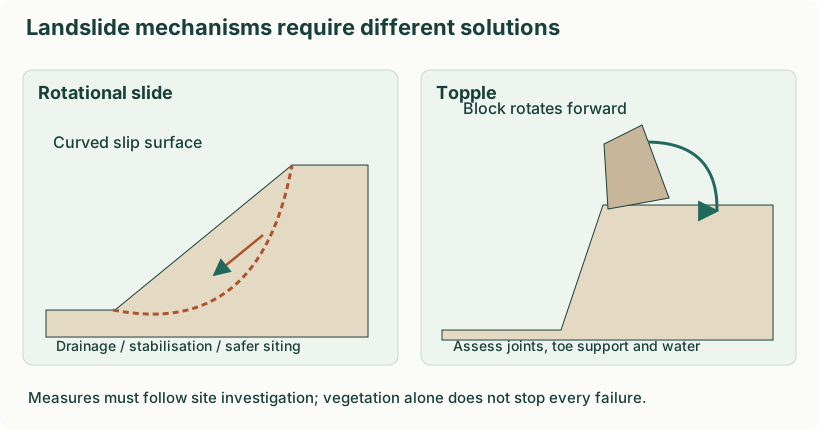
Diagram: Landslide mechanisms require different solutions. Labels: Landslide mechanisms require different solutions | Landslide mechanisms require different solutions | Rotational slide | Topple | Curved slip surface | Drainage / stabilisation / safer siting | Block rotates forward | Assess joints, toe support and water | Measures must follow site investigation; vegetation alone does not stop every failure.
Four causes
- Rainfall and saturation. Water increases pore pressure and reduces effective resistance along a potential slip surface. Prolonged or intense rain can therefore destabilise an already weak slope.
- Earthquake shaking. Shaking adds dynamic forces and can dislodge fractured rock or weaken soil. Unstable slopes may fail during or after a strong earthquake.
- Loss of support or vegetation. River erosion, road cutting and excavation remove support at the toe; loss of roots can reduce shallow soil reinforcement.
- Weak or unfavourable geology. Steep slopes, weathered material and joints or bedding dipping toward the valley can make movement easier. Construction loads may further disturb the balance.
Four mitigation measures
- Control water. Maintain surface drains and, where designed, subsurface drainage. Diverting water safely reduces saturation; do not discharge it onto another unstable slope.
- Stabilise the slope. Qualified engineers can use retaining structures, anchors, soil nails or regrading after investigation. The design must suit the failure mechanism and include drainage.
- Protect cover and regulate land use. Restore suitable vegetation, limit quarrying and avoid unsafe toe cutting or building on unstable ground. Vegetation helps some shallow failures but cannot stop every deep landslide.
- Map, monitor and prepare. Use susceptibility maps, rainfall observations and movement indicators to prioritise closures and evacuation. Mark safe routes and train residents to report new cracks or tilting structures.
Fifth measure: reduce exposure. Where stabilisation is unreliable or impractical, restrict access or relocate threatened assets through fair, planned processes. This protects people even when the slope hazard remains.