Advertising and Public Relations · TEE · papers
Q7 · Discuss the Case Study of Airtel by explaining: (i) Background of the case study (ii) PR strategy (iii) Outcome
2025-05-13 · Semester VI final / re-exam
Actual TEE paper · 100 marks · Q1 compulsory + any four complete Q2–Q7
Archive copies conflict on Q7: one prints 10 and another corrects it to 20 by hand. The displayed 20 preparation marks follow the equal-question instruction and 100-mark attempt rule; they are not an unambiguous printed allocation.
2025-05-13 · Q7 · Previous-paper question. Discuss the Case Study of Airtel by explaining: (i) Background of the case study (ii) PR strategy (iii) Outcome. [20 preparation marks]
Answer
1. Background and communication problem
2. Strategy and application of concepts
- Background: Network quality is a central concern for telecom customers. A credible response requires both service improvement and understandable information.
- PR approach: Sharing relevant network information can respond to customer uncertainty and enable questions. The purpose is relationship management around service, not merely a brand slogan.
- Audience and channels: Customers need practical coverage information; journalists need a factual explanation; staff need consistent answers; relevant authorities have a distinct oversight role.
- Supporting action: A transparency tool must use accurate information and be accompanied by the promised operational work. A map alone does not improve service.
- Evaluation: Assess whether information is accessible, understood and useful, alongside independently appropriate service-quality measures.
- Application: The case illustrates how communication and customer experience need alignment. Use it to explain credibility, digital channels and two-way engagement.
3. Outcome and what the evidence permits
The initiative and its information-sharing purpose are documented. A causal improvement in reputation or a specific sales increase is not established by the reviewed release.
4. Critical comments
- The older paper says only “Case Study of Airtel” and does not identify a campaign. Open Network is a documented example, not a claim that it is definitely the same classroom case.
- Do not treat a company announcement as independent proof that every location achieved the intended service quality.
- Keep programme objectives separate from verified measured results.
5. Conclusion
The case is useful because it connects a defined audience need with a recognisable message and supporting action. A strong exam answer explains those connections and separates observed facts from assumptions about impact.
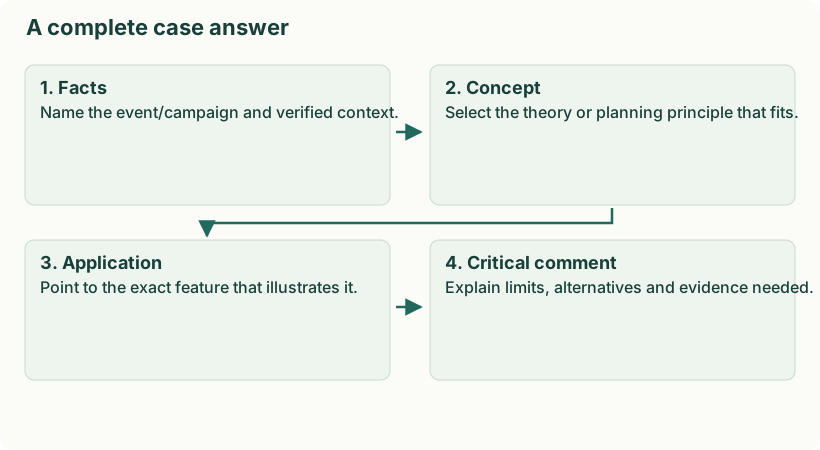
Diagram: A complete case answer. Labels: A complete case answer | A complete case answer | 1. Facts | Name the event/campaign and verified context. | 2. Concept | Select the theory or planning principle that fits. | 3. Application | Point to the exact feature that illustrates it. | 4. Critical comment | Explain limits, alternatives and evidence needed.